
Low-pressure cleaning physically removes organic growth from the roof surface, delivering instant visual results and eliminating buildup that cannot be fully removed by chemical treatments alone.
This method allows for deep, thorough cleaning while minimising stress on roof materials. Using adjustable pressure settings and professional attachments such as double turbo nozzles or surface cleaners, we can remove heavy moss, algae, and lichen efficiently — including growth embedded between tiles where manual scraping alone may not reach.Unlike chemical-only treatments, low-pressure washing physically removes organic growth on contact, delivering instant visual results rather than relying solely on delayed biological breakdown.
Low-pressure cleaning offers a high level of control, allowing us to adapt water pressure to the roof’s condition and material. This ensures effective cleaning while protecting the integrity of tiles and fixings.It also reaches areas that are difficult to access manually, flushing out moss and debris from joints, overlaps, and tile edges where moisture and spores typically remain trapped.
To complete the process, we apply a professional biocide treatment that targets remaining spores and slows regrowth. While low-pressure washing delivers immediate visual results, the biocide ensures long-term protection and helps keep your roof cleaner for years to come.
Low-pressure roof cleaning offers a safe, controlled way to remove moss, algae and surface contamination while protecting the structure and integrity of your roof.
While low-pressure roof cleaning delivers excellent results, our priority is always the long-term safety and condition of your roof. We never apply a method simply because it looks good — every decision is based on what is technically appropriate and safe for the structure.
Before recommending any cleaning method, we carry out a detailed roof inspection, often supported by drone imagery. This allows us to identify tile condition, structural weaknesses, previous repairs, and areas at higher risk. The assessment ensures that the chosen method will clean effectively without compromising the integrity of the roof.
Not every roof is suitable for low-pressure washing. Fragile, heavily weathered, or porous tiles may require alternative approaches to avoid unnecessary risk. Our role is to choose the safest and most effective solution — not simply the fastest or most visually dramatic one. Protecting the roof always comes before short-term results.
Safe, controlled and highly effective roof cleaning — delivered by trained specialists using industry-approved equipment.
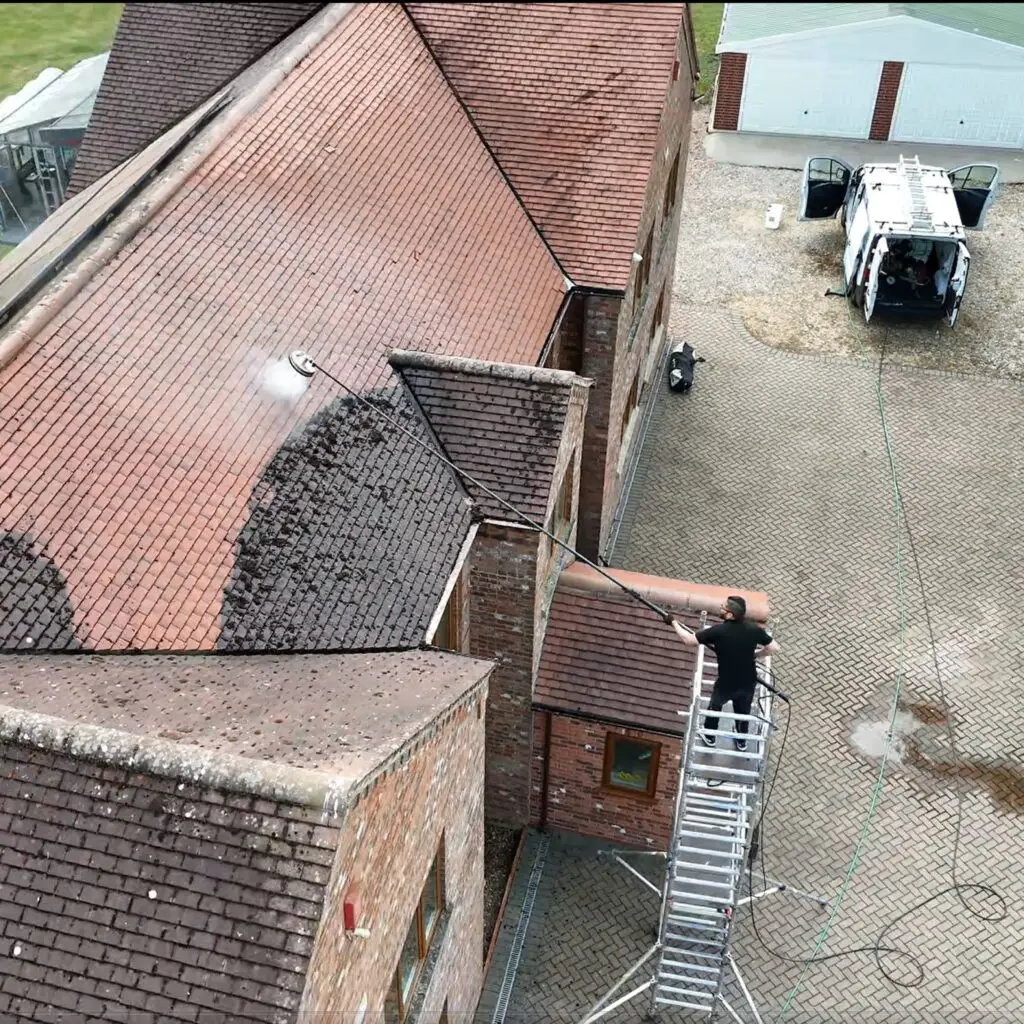
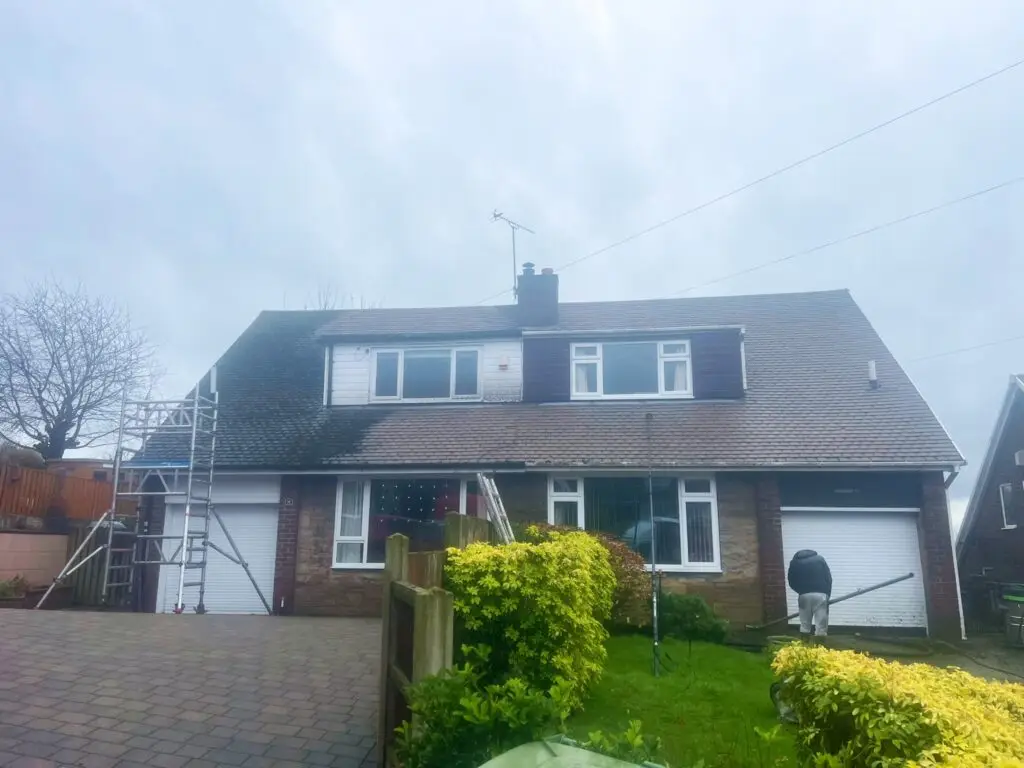
Before cleaning begins, we install a secure scaffold tower to allow safe and stable access to the roof. Our equipment is then set up, including professional pressure systems connected to specialist surface cleaners or twin turbo nozzles. This setup allows us to work efficiently while maintaining full control over water flow and pressure levels.
All cleaning is carried out from the scaffold — we do not walk directly on the roof surface. Using extended lances capable of reaching up to 15 metres, we are able to clean large roof sections without repositioning equipment unnecessarily. Water pressure is precisely regulated through professional control valves, allowing us to match the flow rate to the roof type and level of contamination. This ensures effective removal of moss, algae, and organic build-up while minimising stress on the tiles.
Once a section has been cleaned, the roof is thoroughly rinsed to remove remaining debris and residues. A professional biocide treatment is then applied to inhibit regrowth and provide long-term protection. At the same time, our team carries out a full clean-up of the surrounding area, ensuring all dislodged material is safely removed and the site is left clean and tidy.
Once low-pressure washing has been confirmed as the most suitable method, the cleaning process follows a structured and controlled workflow designed to deliver safe, consistent, and high-quality results.
Not sure if pressure washing is right for your roof? These frequently asked questions explain how the process works and what you can expect.
When done correctly using controlled, low-pressure equipment, roof washing is safe for many roof types. The key is adjusting the pressure to suit the material and condition of the roof. That’s why a professional assessment is essential before any work begins.
Pressure washing removes moss, dirt and organic build-up using controlled water pressure, delivering immediate and visible results.
Soft washing, on the other hand, is a chemical-based process that relies on biocidal solutions — typically sodium hypochlorite combined with surfactants — to break down organic staining and inhibit biological growth over time.
While soft washing is highly effective at treating algae, lichen and surface staining, it does not physically remove heavy moss growth. For this reason, moss usually needs to be manually removed before or alongside chemical treatment. The biocide then continues to work over time, preventing regrowth and improving the long-term appearance of the roof.
In practice, the most effective results are often achieved by combining methods:
manual moss removal where required, followed by controlled cleaning and a biocide application to protect the roof long term.
If done incorrectly or at excessive pressure, it can cause damage. However, professional roof cleaners use specialised equipment and regulated pressure levels to avoid harming tiles or underlying structures.
No. Some roofs — especially very old, fragile, or with damaged tiles — may not be suitable for pressure washing. In these cases, alternative methods such as soft washing or manual cleaning are recommended.
Results can last several years, especially when followed by a biocide treatment. The exact duration depends on environmental factors such as shade, moisture, and nearby vegetation. Our service is ALWAYS combined with Biocide Treatment to extend the results as long as possible.
Yes. Pressure washing physically removes moss, algae, and built-up debris, including material embedded between tiles. A biocide treatment is then applied to help prevent regrowth.
hen carried out professionally, pressure washing does not cause leaks. Risks usually occur only when inappropriate pressure or poor technique is used. That’s why inspection and correct equipment are essential.
No. As long as access is available and arrangements are confirmed, the work can be completed without you being present.
Most residential roofs are completed within couple of hours to one day, depending on size, access, and the level of contamination.
The process does generate debris, but all waste is managed and removed as part of the service. Surrounding areas are protected, and the site is left clean once work is completed.
Older, brittle, or heavily weathered tiles may be vulnerable to damage under pressure. In these cases, even reduced water pressure can cause surface erosion, cracking, or displacement of tiles. For such roofs, gentler cleaning methods are often the safer and more responsible choice.
Some roofing materials naturally become more porous over time. When this happens, water can penetrate more easily beneath the surface. Applying pressure in these conditions may increase the risk of moisture ingress, making alternative low-impact methods a better solution.
If a roof shows signs of poor fixing, movement, or previous structural problems, pressure washing may introduce unnecessary stress. In these situations, we prioritise stabilising and protecting the roof rather than applying force that could worsen existing issues.
While pressure washing delivers instant visual improvement, it is not always the best option for long-term preservation. In some cases, controlled manual cleaning combined with targeted biocide treatments offers a safer and more sustainable outcome
While pressure washing is an effective cleaning method in many situations, it is not suitable for every roof. Choosing the wrong approach can lead to unnecessary damage, which is why we always assess whether pressure washing is truly the safest and most appropriate option.